
Heard County Sex Offender Checks
Three official channels cover different parts of a Heard County registry search. The Heard County Community Notification interface, linked by the sheriff, focuses on local names and places. The Georgia Bureau of Investigation registry program explains the statewide system maintained by GBI and the Georgia Crime Information Center. The National Sex Offender Public Website, or NSOPW, reaches participating registries beyond Georgia.
Start with the question. Use the county interface for a street, ZIP, city, radius, or Heard County filter. Use the Georgia source when a person may have moved elsewhere in the state. Add NSOPW when a move across a state line is possible. Names alone can create false matches. Compare aliases, physical details, offense data, registry identifiers, and the last verification date before drawing a conclusion.
Heard County Registry Duties
Georgia divides registry work between GCIC and county sheriffs. GCIC maintains the central public system under O.C.G.A. § 42-1-12. The Heard County Sheriff's Office registers and verifies people who reside in Heard County and supplies the local facts that support public notification. This split explains why the statewide page and sheriff-linked interface may look different even when both trace back to official records.
The registration office is at 11820 Highway 100 North, Franklin, GA 30217, and the main number is (706) 675-3329. Published sources do not state counter hours, required documents, or a fixed verification schedule for every registrant. Call before a visit. The office can also receive a report of suspected noncompliance. Do not confront the person named in a result.
Heard County Sheriff's Office
11820 Highway 100 North
Franklin, GA 30217
(706) 675-3329
Call to confirm registration-office hours and reporting requirements.
Georgia Sex Offender Registry Searches
The Georgia Sex Offender Registry supports both a person search and a place-based Heard County lookup. Search controls can change, but the research inventory confirms name, offender ID, address, city, ZIP, county, and radius fields. A broad county filter is useful for awareness. A name search is better when the identity is known. An address or radius query answers a location question, but it should not be treated as live tracking.
- Open the sheriff-linked Heard County interface or the GBI registry and read the use notice.
- Enter a last name and first name, or choose Heard County and add a city, ZIP, address, or radius.
- Review the result list. Match more than a name by comparing the registry ID, aliases, age treatment, and physical description.
- Open the profile. Read the offense, status, address, reporting sheriff, and verification date together.
| Field Label | Type | Required | Notes |
|---|---|---|---|
| Last Name | Text | No | Spelling and aliases can affect matches. |
| First Name | Text | No | Narrows a common surname. |
| Offender ID | Text | No | Use an exact registry identifier when known. |
| City / ZIP Code | Text or select | No | Try Franklin, Ephesus, Centralhatchee, or the mailing city. |
| County | Select | No | Select Heard for countywide results. |
| Address / Radius | Text and select | Conditional | Distance options depend on the live interface. |
Heard County Registry Layers
The Heard County interface is the strongest first stop for a neighborhood or county question. NSOPW is the better second layer when the person, offense, or former address may connect to another state, territory, tribal jurisdiction, or the District of Columbia. NSOPW gathers participating public records but does not replace the jurisdiction that owns each profile.
If the two result sets disagree, check whether one used an alias, a former address, or a different spelling. Then follow the national result back to its source jurisdiction and compare update dates. For a Heard County address, call the sheriff when the conflict matters. A missing NSOPW result does not prove that no registration record exists, since participation, system outages, CAPTCHA controls, and reporting delays can affect a search.
The Department of Justice overview of NSOPW explains that the national tool routes users to the public record supplied by each jurisdiction.
The national search image below shows the cross-jurisdiction layer without replacing the Heard County source.
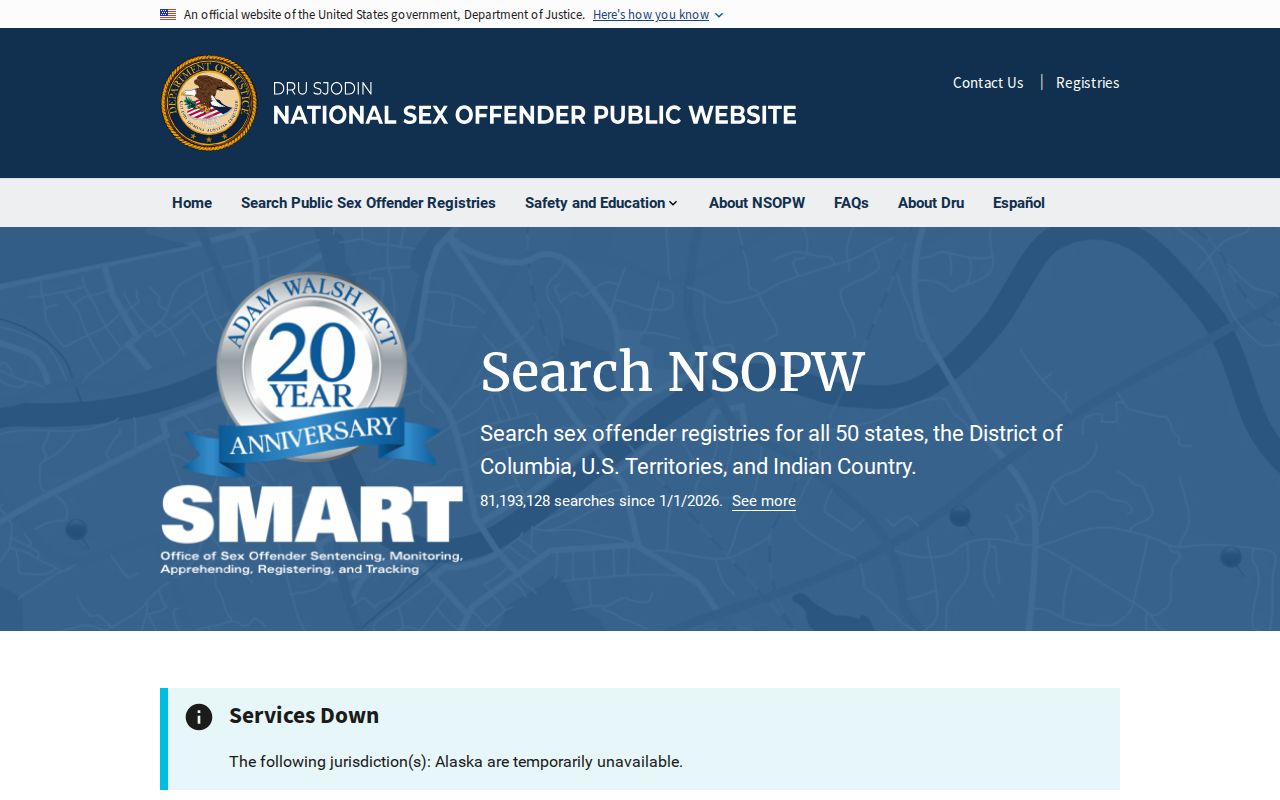
Use any national match to locate the maintaining agency, then verify the current profile there.
Registry Profiles: What They Show
A Heard County registry profile combines identifying details with the facts that support registration and public notice. Not every field appears on every record. The profile can include a current photograph, prior image, marks or tattoos, vehicle data, an employer or school field when Georgia law allows it, and details about the conviction. Read the status and verification date as carefully as the address.
| Name & Aliases | Legal name, known alternate names, and the registry identifier. |
|---|---|
| Photo & Description | Images, sex, race, height, weight, hair, eyes, scars, marks, and tattoos when supplied. |
| Registered Address | The reported residence and registration jurisdiction, not a live location guarantee. |
| Offense & Case Facts | Offense description or statute, conviction date and jurisdiction, plus sentence or release data when displayed. |
| Other Public Fields | Vehicle, employer, school, or victim age category only when lawfully published and available. |
| Registration Status | Registered or absconded status, verification date, and reporting sheriff. |
Heard County Registry Address Limits
A plotted point is a reported address. It does not show where a person stands now. Moves, new reports, agency review, and system publication can create a gap between real life and the displayed record. Street names and municipal mailing addresses can also complicate a Heard County radius search. Someone near Franklin may use a mailing city that differs from the place a searcher expects.
Match the address with the verification date and reporting sheriff. If safety planning depends on the answer, confirm it with the Heard County Sheriff's Office. Do not visit an address to test a result. Similar names, old photographs, and incomplete physical details also make a single-field match unsafe.
Note: A registry address supports public awareness, but it is neither a real-time location feed nor proof of current presence.
Registration Levels and Duties in Georgia
Georgia does not use a simple public Tier I, Tier II, and Tier III chart that assigns one standard duration to each label. Duties depend on the offense, relevant dates, release, statutory classification, and risk or designation rules. Some people must register for life. A limited group may petition for removal only after the time and risk conditions set by Georgia law are met. The court, not a website label, decides a qualifying petition.
| Georgia Category | Duration | Public Meaning |
|---|---|---|
| Statutory registrant | Set by the governing offense, dates, release, and O.C.G.A. § 42-1-12 | The public profile should be read with its actual status and offense facts. |
| Lifetime duty | Life for people covered by the applicable statutory provisions | Do not infer lifetime status from an unofficial tier chart. |
| Potential removal petitioner | Only after required time and risk conditions are satisfied | Eligibility is limited and requires a court petition; it is not automatic. |
GBI and Heard County Registry Data
The GBI program page is the official starting point for Georgia registry law, administration, and statewide context. It helps a Heard County searcher distinguish GCIC's central role from the sheriff's local verification duties. The page does not turn a registry hit into proof of a new crime, current presence, or conduct beyond the published registration record.
The GBI registry information source is captured in the image below.
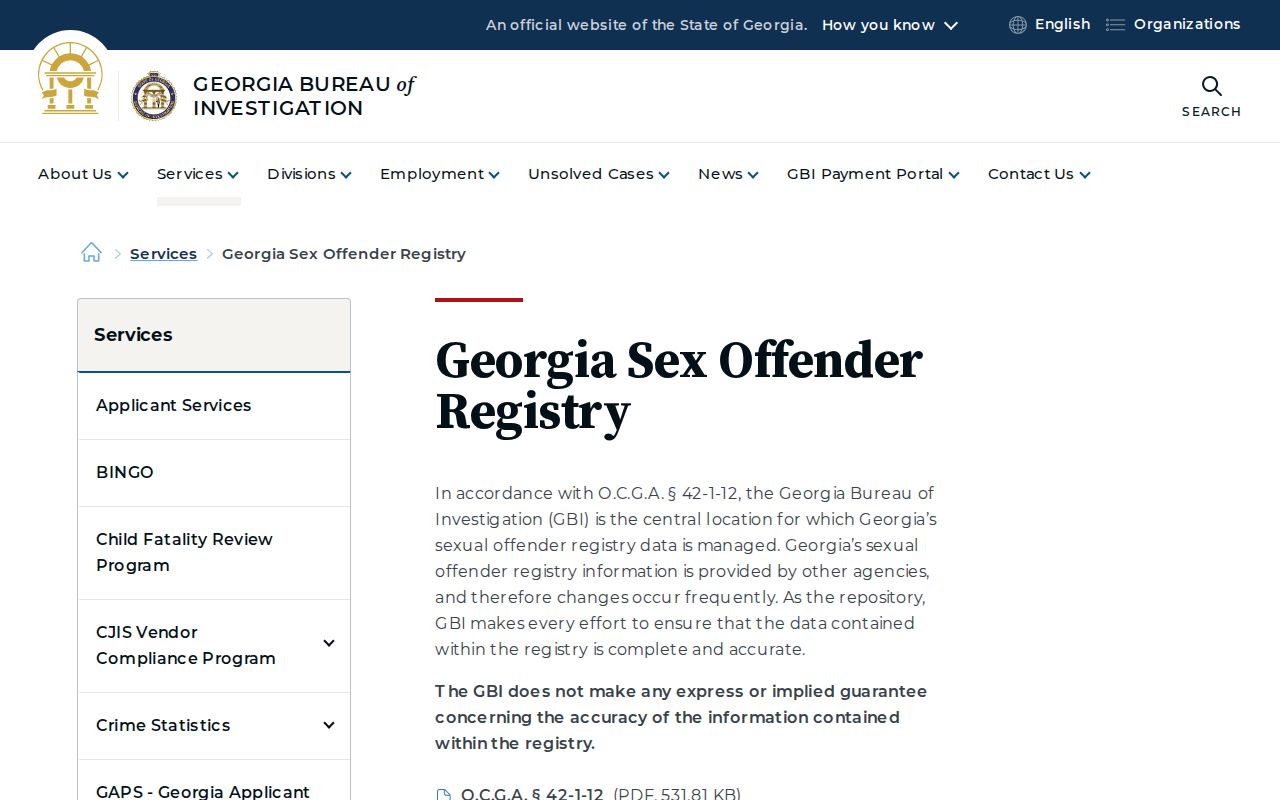
That statewide source should be paired with the sheriff-linked Heard County search when the address or reporting office is local.
Report Heard County Registry Noncompliance
Suspected noncompliance belongs with law enforcement. Write down the public profile's name, registry ID, displayed address, status, and verification date. Note the specific fact that appears inconsistent, but do not investigate the person or property. Call the Heard County Sheriff's Office at (706) 675-3329 when the record reports Heard County as the registration jurisdiction.
For an immediate threat, use the proper emergency channel. For a record mismatch without an urgent safety issue, ask the registration office to check its source data. A citizen report can point the custodian to a possible problem; it does not establish a violation. The sheriff decides what verification or enforcement step is warranted.
Using Registry Information Lawfully
Public registry information supports family safety, neighborhood awareness, and informed planning. It does not authorize a searcher to punish, threaten, track, or expose a registrant's household. Use official notification tools and law-enforcement channels. When a result appears wrong, preserve the record details and contact the maintaining sheriff rather than posting an accusation.
Misuse is forbidden: Registry warnings prohibit harassment, threats, intimidation, vigilantism, and use of the data to commit a crime. Misconduct may be prosecuted under Georgia law. Report suspected violations to the Heard County Sheriff's Office instead of confronting anyone.